SAMBA RISE
USA-BRAZIL PROJECT
Cartola
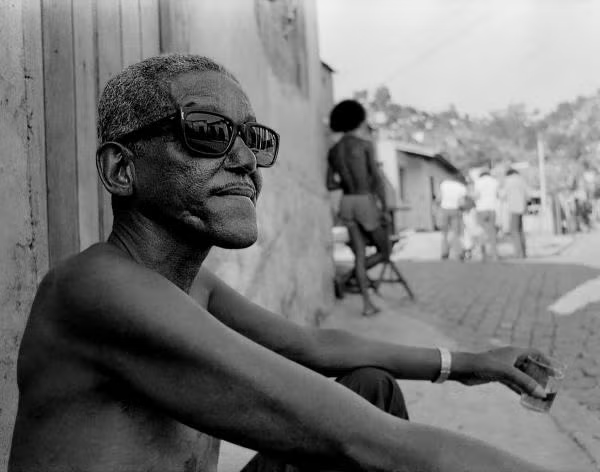
The Poet of the Hill
Angenor de Oliveira, known to Brazil as Cartola, was born on 11 October 1908 in Catete, Rio de Janeiro, and raised amid the music, hardship, and community of Mangueira. The nickname came from a humble workplace detail: as a young bricklayer he wore a bowler hat to keep cement out of his hair, and colleagues called him “Cartola”—top hat. That modest image would become the name of one of samba’s greatest composers.
After his mother’s death he left school and lived the bohemian life of the morro. In 1928, with friends including Carlos Cachaça, he helped found Estação Primeira de Mangueira and wrote its first samba, “Chega de Demanda.” Through the 1930s his songs were recorded by stars such as Francisco Alves and Carmen Miranda, yet Cartola himself remained a hill composer more than a recording star. Illness and poverty later pulled him from the scene; in the 1950s the writer Sérgio Porto found him washing cars in Ipanema and helped bring him back. With Dona Zica he opened the restaurant Zicartola in 1964, a meeting place for traditional sambistas and a new generation. Only in 1974, at sixty-five, did he record his first solo album. He died on 30 November 1980.
Cartola’s gift was to turn everyday feeling into melody of rare tenderness: love, time, pride, and the dawn over the favela. Late recognition did not diminish the work. His voice—fragile, precise, almost spoken—made the songs feel like confidences rather than performances.
Cartola did not invent samba, but he gave it a lasting inner voice:
"the sound of a man who had seen the city from the hillside and still chose to sing".
USA Address:
2787 East Oakland Park Blvd Suite 307
Fort Lauderdale Fl. 33306
"Copyright" 2023 Paul Calvenzani
"All Rights Reserved"